










Introduction
Arbitration has a long history of contributing to both the avoidance and ending of wars. The Jay Treaty of 1794 between the United States and Great Britain established arbitral commissions to settle disputes over boundaries, maritime claims and debts.[1] The Treaty of Washington of 1871 created a tribunal to resolve claims concerning British-built Confederate warships.[2] And the Bering Sea Arbitration in 1893 again averted escalation between the United States and Great Britain over seal-fishing rights.[3]
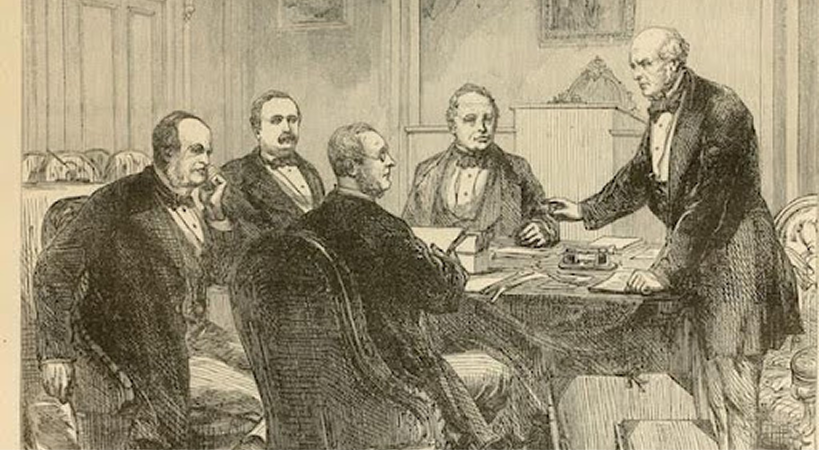
The Geneva Board of Arbitration Settling the Alabama Claims, c. 1872.
At the turn of the 20th Century, against the backdrop of a quickening arms race in Europe, the 1899 and 1907 Conventions for the Pacific Settlement of International Disputes called for the amicable resolution of disputes before an appeal to arms. They recognised that, where issues of law arise, “arbitration is … the most effective, and at the same time the most equitable, means of settling disputes which diplomacy has failed to settle.”[4]
That history of helping to avoid war and find peace continued over the last century. Territorial disputes amidst armed conflict were addressed by tribunals in the 1968 Rann of Kutch Arbitration, the 1977 Beagle Channel Arbitration, and the 1988 Taba Arbitration, in each case laying the foundations for peace.[5]
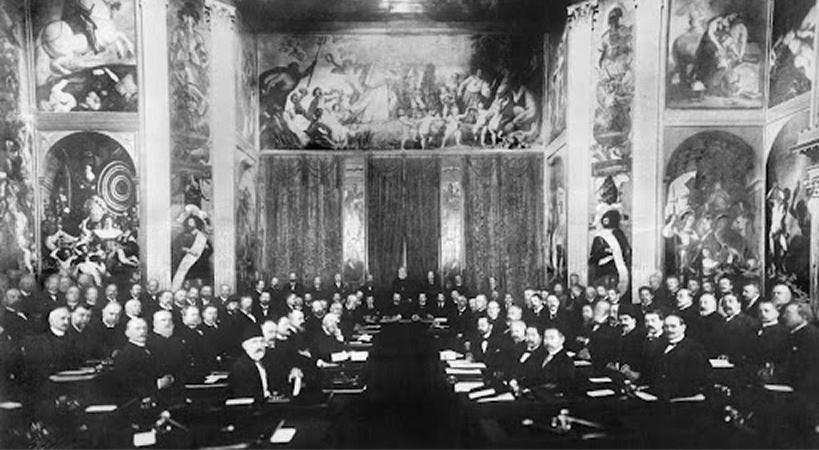
The First International Peace Conference, The Hague, May, c. 1899
More recently, arbitration has played an important role in bringing peace to Bosnia and Herzegovina as part of the Dayton Peace Agreement,[6] in helping to normalise bilateral State relationships, for example as between New Zealand and France, following the bombing of the Rainbow Warrior in 1985,[7] and as between the United States and Chile, following Chilean state-sponsored assassinations on US soil in the early 1990s.[8]
Arbitration has often been used alongside other alternative dispute resolution mechanisms, such as mediation. For example, in the Beagle Channel Dispute, the 1977 arbitration was followed by Papal mediation, which ultimately led to the conclusion of a peace treaty in 1984, integrating the legal foundation established by arbitration with the diplomatic progress achieved through mediation. In the Rainbow Warrior dispute, a 1986 UN Secretary-General-administered mediation was followed by arbitration proceedings in 1990 to resolve the outstanding disagreements arising from the incident.
Drawing on an extensive review of past arbitration proceedings, we identify in this ‘toolkit’ a series of features of the arbitration process that have been, and could be, useful in the context of peace processes. Arbitration is neutral and offers procedural flexibility, enabling parties to tailor the dispute- resolution process to the particularities and sensitivities of each case. Features of the arbitration process that make it suited to conflict resolution include:
- The ability to choose the decision makers, the applicable rules, and the venue;
- The ability to define and delimit the scope of the arbitral tribunal’s decisionmaking powers;
- The ability to select the substantive rules by which the dispute will be determined;
- The ability to arrive at resolutions without admissions of liability;
- The ability to determine disputes within timelines that are consistent with making progress in a peace process;
- The accommodation of quasi-State or non-State entities as parties to an arbitration;
- The potential for mass-claims mechanisms to address damage caused to large numbers of individuals;
- The ability to incorporate either transparency or confidentiality measures, as most appropriate to the peace-making circumstances;
- The ability to agree privileges and immunities for arbitration participants;
- The availability of arbitral post-decision implementation tools to promote compliance and stability.
In this toolkit, we describe:
- how arbitration has been used in the past in peace processes; and
- what features of arbitration are suited to peace-making.
HOW ARBITRATION HAS BEEN USED IN PEACE PROCESSES
Arbitration before or in lieu of peace agreements
Arbitration can be employed directly to resolve a conflict without recourse to a politically negotiated peace agreement. In the context of the 1995 Eritrea– Yemen armed conflict over the Hanish Islands in the southern Red Sea, the parties sought arbitral resolution, by signing the Eritrea–Yemen Arbitration Agreement. This provided for two sequential arbitration awards to determine, first, territorial sovereignty and, second, the resulting maritime boundary delimitation.[9] Following the issuance of the awards, both parties committed to their implementation, hostilities did not resume and the relationship between the parties was normalised.[10]
In other cases, arbitration – sometimes employed alongside other alternative dispute resolution mechanisms – can pave the way for the eventual conclusion of a peace agreement. That was the case in the Beagle Channel Arbitration between Argentina and Chile over sovereignty of the Picton, Lennox and Nueva Islands. Following recurring tensions under the 1881 Boundary Treaty, the parties signed a treaty in 1971, agreeing to submit their dispute to binding arbitration under the auspices of Queen Elizabeth II as appointing authority for a five-member tribunal.[11]
On 18 April 1977, the tribunal issued its final award, awarding sovereignty over all three islands to Chile.[12] Although formally binding, Argentina rejected the 1977 Award and prepared for military action, prompting Papal intervention. The parties then agreed to the Act of Montevideo of 1979, under which they committed to suspend military operations, maintain the territorial status quo and enter Papal mediation, which culminated in the Treaty of Peace and Friendship of 1984.[13]
The 1984 Treaty built upon the legal foundation of the earlier arbitration, as well as the diplomatic gains achieved through mediation, and committed both States to peaceful settlement of future disputes.
Arbitration agreements within peace agreements
Peace agreements may incorporate arbitration mechanisms directly within their framework to resolve residual or sensitive disputes that could otherwise threaten implementation.
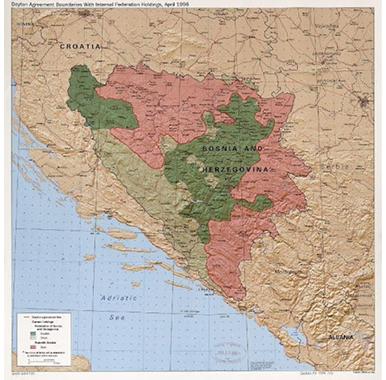
Dayton Agreement Boundaries, c. 1996
The General Framework Agreement for Peace in Bosnia and Herzegovina (the Dayton Peace Agreement), concluded in November 1995 to end the Bosnian War, included provisions on military and civilian implementation, constitutional arrangements and human rights protection. It also contained an arbitration agreement requiring the Federation of Bosnia and Herzegovina and Republika Srpska to submit to binding arbitration the determination of the disputed portion of the Inter-Entity Boundary Line in the Brčko area (the Brčko Arbitration). [14] This successful delegation of one specific issue to resolution by arbitration is discussed in greater details below.
Arbitration as a means of implementing or guaranteeing peace agreements
Arbitration has also been used after the conclusion of peace agreements to resolve disputes that arise during their implementation.
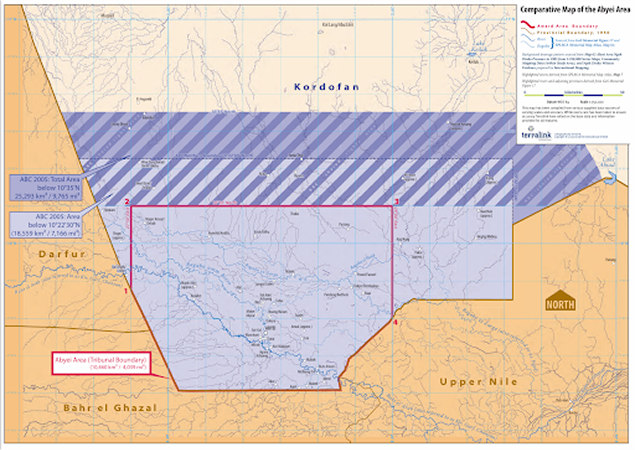
Comparative Map of the Abyei Area appended to the tribunal’s award
A notable example is the Abyei Arbitration, established under the 2005 Comprehensive Peace Agreement (CPA) between the Government of Sudan and the Sudan People’s Liberation Movement/Army (SPLM). Although the CPA ended decades of civil war, it left unresolved questions regarding the resource-rich Abyei area. The CPA incorporated the previously signed Abyei Protocol that designated Abyei as a special administrative area, whose boundaries would be determined by the Abyei Boundaries Commission (ABC).[15] When the ABC’s report was rejected by the Government of Sudan as exceeding its mandate, tensions reignited. To avert renewed conflict, the Government and SPLM agreed to refer the dispute over the ABC’s finding to arbitration.[16]
WHAT FEATURES OF ARBITRATION ARE SUITED TO PEACE-MAKING
Choosing your arbitrators, your rules and your venue
In the context of avoiding war, or finding peace, the ability to choose the identity of the decision-makers, the rules being applied and the location of the process can be key in demonstrating the neutrality on which the legitimacy, and therefore acceptability, of a conflict resolution process will depend. The arbitration process offers participants all of these choices.
It is a fundamental feature of the arbitration process that the participants can choose their decision-makers, or at least the means by which they are chosen. In the Brčko Arbitration, for example, the parties appointed a three member tribunal composed of: Professor Cazim Sadikovic, a Bosnian (Bosniak) arbitrator selected by the Federation of Bosnia and Herzegovina; Dr Vitomir Popovic, a Bosnian Serb arbitrator appointed by Republika Srpska; and following the partyappointed arbitrators’ failure to agree on a presiding arbitrator, the President of the International Court of Justice (ICJ) appointed a US State Department lawyer Roberts B Owen.[17] The Island of Palmas Arbitration was determined by a sole arbitrator: then-member of the Permanent Court of Arbitration (PCA) and Swiss national, Max Huber.[18]
The Arbitral Process also allows participants to choose the rules that will govern their procedure. These procedural rules can be tailored to the political sensitivities and needs of the participants, or drawn from preexisting rules adopted through the broadest international consensus, such as the UNCITRAL Arbitration Rules, which were promulgated by the UN General Assembly.
Arbitration also allows parties to choose the venue of their process, thereby allowing the process to takeplace away from the location of the conflict or its participants so as to enhance the neutrality and legitimacy of proceedings. By way of example, the Brčko Arbitration hearings were held in Rome and Vienna,[19] while the Indus Waters Arbitration (regarding a dispute between India and Pakistan) took place in The Hague, though the tribunal conducted a site visit to the Neelum River Valley.[20]
The ability to define and delimit the scope of the arbitral tribunal’s decision-making powers and limit its decision parameters
States are likely to want a heightened degree of control over the determination of politically sensitive disputes. Arbitration can offer that control. By way of example, parties can expressly restrict the tribunal’s powers to render a decision exclusively to the proposals/options advanced by either party (so called “baseball arbitration”). In such cases, the tribunal will not be permitted to reach a compromise or its own alternate decision based on the merits of the case and the application of the law. The parties themselves define and delimit the available outcomes.
That was the case in the 1988 Taba Arbitration between Egypt and Israel concerning the implementation of the 1979 Egypt-Israel Peace Treaty. Pursuant to the 1979 Treaty, Israel withdrew from the Sinai Peninsula, except for a small area in Taba. The arbitration, which followed years of failed bilateral negotiations and United States mediation, concerned the determination of the location of boundary markers in Taba. In the arbitration agreement, the parties directed the tribunal to establish the locations of boundary pillars by choosing only from amongst the locations advanced by the parties, and not authorising the tribunal to establish a different location.[21] A majority of the tribunal reached a decision on this basis, and both parties implemented the decision in good faith.[22]
The ability to reach resolution without admission of liability
Parties to multifaceted conflicts may prefer to avoid referring particularly sensitive questions to third-party decision-makers, and may choose instead to use arbitration to resolve narrowly defined issues. By way of example, they may wish to reserve for themselves determination of issues of sovereignty and entitlement, but delegate to a tribunal only consequential questions of compensation and its quantum. Alternatively, the parties may wish to refer a discrete issue to third party determination but expressly without admission of liability.
An example of the latter occurred between the United States and Chile. On 12 January 1989, the United States invoked the 1914 Treaty for the Settlement of Disputes that May Occur Between the United States and Chile (the 1914 Treaty) to investigate and report upon the facts surrounding the 1976 assassination in Washington DC of the exiled Chilean diplomat Orlando Letelier and his American colleague Ronni Karpen Moffitt. The 1914 Treaty provided for the resolution of all disputes between the United States and Chile by submitting them to an “International Commission.”[23]
On 11 June 1990, the United States and Chile agreed that Chile “[w]ithout admitting liability … in order to facilitate the normalisation of relations, is willing to make an ex gratia payment”, the amount of which would be “the sole question to be determined by the Commission.”[24] In concluding that agreement, the parties stated that “[t]he Commission shall determine the amount of the payment to be made by the Government of Chile in accordance with applicable principles of international law, as though liability were established.”[25]
The ability to select the substantive rules by which the dispute will be determined
Arbitration allows parties to select and adapt the substantive rules by which their dispute will be determined, without being confined to any particular national or international system of law. In addition to rules of law, a tribunal could, for example, be tasked with taking into consideration local custom, religious law, or general or equitable principles.[26]
By way of example, as part of the Dayton Peace Agreement, the parties empowered the tribunal to adjudicate the Brčko Arbitration by “apply[ing] relevant legal and equitable principles.”[27] This in turn, empowered the tribunal not only to pass judgment on the legal rights and wrongs of the conflict, but to go further and make a determination that took account of equitable principles “that ha[d] the strongest likelihood of promoting a long-term peaceful solution.”[28]
As a result, rather than recognising either the sovereignty of the two sub-state entities (the Federation of Bosnia and Herzegovina or the competing claim of Republika Srpska), the tribunal instead created a single, self-governing Brčko District under the sovereignty of Bosnia and Herzegovina, with the territory itself held in “condominium” by both sub-state entities, and with governance delegated to a new multi-ethnic district government. [29] And so political face was saved on both sides, and a pragmatic way forward was found that the political leaders themselves had not been able to identify in direct negotiations. In particular:
- While recognising its authority under the arbitration agreement to adjust the Inter-Entity Boundary Line in the Federation’s favour to “alleviate the effects of the [Republika Srpska]’s past violations – and to prevent proposed future violations [30] the tribunal, guided by equitable principles, opted for “less severe remedial steps” that would achieve the same objectives.[31] It identified equitable doctrines relevant to territorial disputes, such as “unclean hands”, contextual fairness, and balancing of the disputants’ interests in light of “the factual context of the dispute – the unique political, economic, historical and geographical circumstances surrounding the dispute.”[32] These interests included the Federation’s “compelling equitable interests in the Brčko area” (including its fundamental interest in providing for the safe return of the previous Muslim and Croat population, and its economic interests in the area), Republika Srpska’s interest in preserving a connecting corridor between its eastern and western parts, the local community’s welfare, and the broader international interest in peace and stability.[33]
-
In addition, the tribunal held that, consistent with equitable principles, it was “authorized to render an award that, in its view, best reflects and protects the overall interests of the parties and that has the strongest likelihood of promoting a long-term peaceful solution.” Accordingly, beyond fixing the final position of the Inter-Entity Boundary Line, the tribunal considered that it was also empowered to call upon the international community to establish an interim supervisory regime in the Brčko area.[34]
The ability to determine disputes within timelines that are consistent with making progress in a peace process
Prompt resolution of disputes can be essential to sustaining peace processes and preventing renewed instability. Strict procedural timetables can serve as both an incentive for cooperation and a safeguard against political backsliding. Arbitration can be tailored to achieve any timeline – including expedited timelines – that is politically desirable, in contrast to the protracted timelines often associated with standing international courts.[35]
The Abyei Arbitration exemplifies the effective use of expedited procedures. Under the arbitration agreement, the tribunal was required to issue its final award within six months of its constitution, extendable only once by an additional three months. The tribunal held hearings in April 2009 and delivered its Final Award in July 2009 – approximately 90 days after the close of oral proceedings. Despite the complexity and sensitivity of the dispute, the tribunal and the parties adhered to this accelerated timetable. In the Letelier–Moffitt Arbitration between the United States and Chile, the parties agreed to thirty-day deadlines for their written presentations, followed by ten-day deadlines to reply,[36] and mandated that the Commission reach its decision determining the amount of compensation within thirty days of the final submissions.[37]
The accommodation of quasi-state and non-state actors as parties
Effective peace processes often require mechanisms capable of resolving disputes between sovereign States and non-State actors, actors whose statehood is not recognised by at least one other party to the conflict, and/or competing governments within the same State. This may prevent parties to the conflict from submitting their disputes to a permanent adjudicatory body, such as the ICJ, whose competence is limited to inter-State disputes.[38] In such cases, ad hoc arbitration will be a more suitable option.
The Abyei Arbitration between the Government of Sudan and SPLM is an example of this.[39] The parties signed an arbitration agreement on 7 July 2008, submitting their dispute to a five-person arbitral tribunal constituted under the PCA Optional Rules for Arbitrating Disputes between Two Parties of Which Only One is a State, with the proceeding administered by the PCA.[40]
The scope for mass claims mechanisms
The transition from armed conflict to peace often requires addressing widespread damage suffered by a large number of individuals and entities. To resolve such claims at scale, States have at times established mass-claims processes administered by tribunals or commissions with mandates to process large numbers of similar claims arising from a single conflict.[41] These hybrid bodies, often blending features of arbitration and administrative adjudication, require flexible procedural frameworks that enable them to apply tailored procedures and evidentiary standards, and to prioritise, consolidate or group claims where appropriate.
An example is the Eritrea-Ethiopia Claims Commission (EECC), established pursuant to the 2000 Peace Agreement between the Governments of Eritrea and Ethiopia (the Algiers Agreement).[42] The Algiers Agreement terminated military hostilities between the two States resulting from their border dispute.[43] It also provided for the establishment of three bodies to address political and legal questions arising from the conflict: (i) an independent body created under the Organisation of African Unity to “determine the origins of the conflict”, which was never established;[44] (ii) the Eritrea-Ethiopia Boundary Commission to delimit and demarcate the border;[45] and (iii) the PCA-administered EECC to decide through binding arbitration all claims by one government against the other or by nationals of one party against the other party’s government or entities it owned or controlled, that were related to the conflict and resulted from violations of international humanitarian law or other international law. [46]
Under the Algiers Agreement, the EECC was required to apply relevant rules of international law and was expressly precluded from deciding ex aequo et bono.[47] At the same time, it was granted wide procedural autonomy to accommodate the mass nature of the claims. Its Rules of Procedure were based on a modified version of the PCA Optional Rules for Arbitrating Disputes between Two States.[48] The EECC had the authority to adopt efficient case management and mass claims processing as it deemed appropriate,[49] and it exercised discretion in practice by:
- Establishing “a simplified ‘fast-track’ damages phase, involving a limited number of legal pleadings and evidence as well as a tight schedule of hearings”;[50]
- Dividing claimed damages into groups: one group for damages associated with loss of destruction of property and infrastructure, medical/health harms, war-related civilian effects, and other direct physical losses;[51] one group for damages associated with nationality and expatriate issues, wrongful expulsion, non-resident property losses, unlawful detention, and diplomatic claims;[52] and individual claims;[53] and
-
Contemplating the potential use of standardised claims forms to support a “mass claims system” for large numbers of individual claimants.[54]
Other key features of the EECC’s procedure included the possibility, at either party’s request, to prioritise certain categories of claims[55] and to adopt flexible evidentiary standards, allowing the EECC to determine freely the “admissibility, relevance, materiality and weight” of any evidence offered.[56]
The potential for proceedings to be transparent or confidential
Peace processes sometimes require transparency, sometimes strict confidentiality, and sometimes a bit of both. Arbitration offers its participants the possibility of a tailor-made approach.
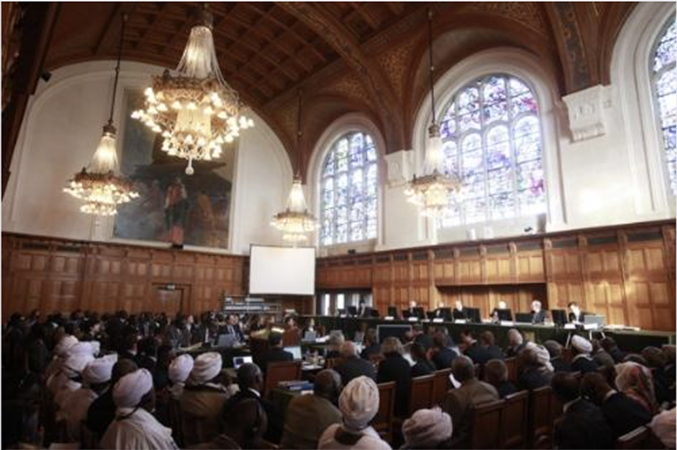
Abyei Arbitration, Oral Pleadings, 18 March 2009
The confidentiality of proceedings remains the default rule in inter-State and intra-State arbitrations, unless the parties agree otherwise.[57] From this starting point, parties can agree graduated levels of transparency. Drawing inspiration from commercial arbitrations, parties can make certain aspects of the proceedings confidential, such as oral or written pleadings, or redact references to certain documents or individuals to protect privacy or national security interests,[58] or hold hearings in camera. By way of example, both the Brčko Arbitration and Rainbow Warrior Arbitration proceedings were conducted on a confidential basis, with only the resulting awards being made public.[59] In other cases, such as the arbitrations initiated by Qatar under the Constitution of the Universal Postal Union against Bahrain, Egypt, Saudi Arabia and the United Arab Emirates, both the proceedings and any resulting decisions remain confidential.[60]
Alternatively, where transparency is considered to be an important element of establishing the legitimacy of the process, arbitrations can be conducted in the open. By way of example, the Abyei Arbitration, was conducted in a very public manner, with televised oral hearings.[61]
Privileges and immunities for participants in the arbitration process
To safeguard the integrity and effectiveness of the arbitral process and prevent further aggravation of the underlying dispute, parties may explicitly agree to accord privileges and immunities to participants in the proceedings (including party representatives, counsel, experts, witnesses and arbitrators) both during the arbitration and after its conclusion.
By way of example, in two inter-State arbitrations initiated in 2023 in the context of the broader Armenia- Azerbaijan border conflict, the rules of procedure provide that each party shall, within its territory, grant participants in the arbitration “such privileges and immunities as are necessary for the effective exercise of their functions in connection with the arbitration.”[62] These include “immunity from legal process of every kind in respect of words spoken or written and acts done by them in connection with their participation in the arbitration”, with this immunity continuing after the arbitration’s conclusion.[63] In addition, in one of these arbitrations brought under the Bern Convention, the parties explicitly agreed to grant participants “[i]mmunity from personal arrest or detention and from seizure of their personal baggage for the duration of meetings and hearings in connection with the arbitration and the time spent on journeys to and from such meetings or hearings”, as well as “[i]nviolability for all papers and documents relating to the arbitration.”[64]
Post-decision implementation and enforcement tools
Given the absence of centralised enforcement mechanisms in international law comparable to those of domestic legal systems , tribunals and parties have developed a variety of post-award implementation- related mechanisms. Such mechanisms aim to secure compliance, monitor post-award performance, and ensure that dispute-resolution outcomes contribute to lasting peace and stability. Some key examples are discussed below.
1.“SELF-EXECUTING” AWARDS/DECISIONS AND CONTINUING MANDATE UNTIL FULL COMPLIANCE
Disputing parties may agree in advance, or the tribunal may decide, to remain seized of a dispute until full implementation of its award. In addition, the parties or the tribunal may further provide for “non-compliance penalties” to further promote the implementation of the award and the final resolution of the conflict.
In order to ensure the implementation of its award, the tribunal in the Brčko Arbitration ruled that it would remain in existence and retain jurisdiction until such time as the “Supervisor” – appointed by the Office of the High Representative for Bosnia and Herzegovina (OHR) – confirmed (with the OHR’s approval) that the parties were fully in compliance with their obligations under the award and that the institutions established by them were fully functioning.[65] The tribunal drew this power from the Dayton Peace Agreement which provided that the tribunal’s decision “shall be final and binding, and the Parties shall implement it without delay.”[66] The tribunal also held that it retained the authority to modify the award in case of non-compliance. Most notably, the final award provided that non- compliance would result in the rejection of that party’s sovereignty claim over the Brčko area, as a matter of law, rendering the award effectively self-executing.[67]
In other cases, such as the 1968 Rann of Kutch Arbitration dealing with the territorial delimitation of the Indo-Pakistan western boundary following a ceasefire, the arbitration agreement expressly provided that “the Tribunal shall remain in being until its findings have been implemented in full.”[68] Following the rendering of the tribunal award, India and Pakistan jointly demarcated the boundary and, upon completion, the tribunal was formally dissolved in 1969.[69]
2. IMPLEMENTATION MONITORING AND REPORTING
As arbitral awards typically form part of a broader political peace settlement, the overall peace agreements may incorporate various monitoring and reporting mechanisms to ensure compliance and promote the overall sustainability of the peace process. By way of example, as discussed above, the Brčko Arbitration tribunal “call[ed] upon the international community to establish an interim supervisory regime in the Brčko area designed (primarily through implementation of the Dayton Peace Agreement) to allow former Brčko residents to return to their homes, to provide freedom of movement and other human rights throughout the area, to provide proper police protection for all citizens, to encourage economic revitalisation, and to lay the foundation for local representative democratic government.”[70]
3. WITHDRAWAL OF OTHER PENDING CLAIMS AND WAIVER OF FUTURE CLAIMS
To ensure finality in conflict resolution and prevent the exacerbating conflagration of proceedings in multiple fora, parties submitting a dispute to arbitration can agree to withdraw other pending claims and/or waive and release their counterparty from any related future claims. For instance, in the Letelier–Moffitt Arbitration, the parties agreed that following the determination of compensation by the Commission and its payment by Chile, all other outstanding claims and any other possible civil claim of the United States against Chile in regard to that matter would be deemed to be satisfied.[71]
4. POST-AWARD RECONCILIATORY MEASURES
In some instances, tribunals have gone beyond legal determinations to promote reconciliation and restore relations between the parties. In the Rainbow Warrior Arbitration, involving France and New Zealand, the tribunal recommended, amongst the other relief it granted,[72] the establishment of a bilateral fund to foster closer ties between the citizens of the two countries, suggesting an initial French contribution of USD 2 million.[73] The tribunal based this recommendation on “[t]he power of an arbitral tribunal to address recommendations to the parties to a dispute, in addition to the formal finding and obligatory decisions contained in the award, [which] has been recognized in previous arbitral decisions.”[74] The tribunal further explained that “[t]his recommendation, addressed to the two Governments, is intended to assist them in putting an end to the present unhappy affair.”[75] New Zealand’s appointed arbitrator, Sir Kenneth Keith, later observed that the resulting initiative “led to many young citizens of the two countries visiting the other,”[76] highlighting how post-award cooperative measures can reinforce reconciliation and durable normalisation of relations.
CONTACT US
If you would like to discuss anything covered within this toolkit in more detail, please reach out to any of the below key members of our team.
Our practice comprises more than 100 specialist arbitration and international law practitioners, qualified in more than 35 countries, who collectively speak over 35 languages.
Below, we introduce key members of our team.








- Treaty of Amity, Commerce and Navigation between Great Britain and the United States, signed 19 November 1794, entered into force 29 February 1796, 8 Stat 116.
- Treaty of Washington (Amity) between the United States and Great Britain, signed 8 May 1871, entered into force 17 June 1871, 17 Stat 863.
- Award between the United States and the United Kingdom relating to the rights of jurisdiction of United States in the Bering’s sea and the preservation of fur seals, Decision, 15 August 1893, XXVIII UN Reports of International Arbitral Awards 263.
- Convention for the Pacific Settlement of International Disputes, signed 29 July 1899, entered into force 4 September 1900, 187 CTS 410, Article 16; Convention for the Pacific Settlement of International Disputes, signed 18 October 1907, entered into force 26 January 1910, 205 CTS 233, Article 38.
- The Indo-Pakistan Western Boundary (Rann of Kutch) between India and Pakistan (the Rann of Kutch Arbitration), Award, 19 February 1968, XVII UN Reports on International Arbitral Awards 1; Case concerning a dispute between Argentina and Chile concerning the Beagle Channel (the Beagle Channel Arbitration), Report and Decision of the Court of Arbitration, 18 February 1977, XXI UN Reports on International Arbitral Awards 53; Case concerning the location of boundary markers in Taba between Egypt and Israel (the Taba Arbitration), Decision, 29 September 1988, XX UN Reports of International Arbitral Awards 1.
- Republika Srpska v Federation of Bosnia and Herzegovina (Arbitration for the Brčko Area) (the Brčko Arbitration), Award, 14 February 1997 and Final Award, 5 March 1999; General Framework Agreement for Peace in Bosnia and Herzegovina (the Dayton Peace Agreement), initialled 21 November 1995, signed and entered into force 14 December 1995.
- Case concerning the difference between New Zealand and France concerning the interpretation or application of two agreements, concluded on 9 July 1986 between the two States and which related to the problems arising from the Rainbow Warrior Affair (the Rainbow Warrior Arbitration), Decision, 30 April 1990, XX UN Reports on International Arbitral Awards 215.
- Dispute concerning responsibility for the deaths of Letelier and Moffitt (United States of America, Chile) (the Letelier–Moffitt Arbitration), Decision, 11 January 1992, XXV UN Reports on International Arbitral Awards 1.
- Arbitration Agreement between the Government of the State of Eritrea and the Government of the Republic of Yemen, signed 3 October 1996, reproduced in Government of the State of Eritrea v Government of the Republic of Yemen, Award in the Second Stage of the Proceedings (Maritime Delimitation), 17 December 1999, XXII UN Reports on International Arbitral Awards 335, p 374, annex 1.
- Government of the State of Eritrea v Government of the Republic of Yemen, Award in the First Stage of the Proceedings (Territorial Sovereignty and Scope of the Dispute), 9 October 1998, XXII UN Reports on International Arbitral Awards 209; and Award in the Second Stage of the Proceedings (Maritime Delimitation), 17 December 1999, XXII UN Reports on International Arbitral Awards 335; B Kwiatkowska, ‘The Eritrea-Yemen Arbitration: Landmark Progress in the Acquisition of Territorial Sovereignty and Equitable Maritime Boundary Delimitation’, 32 Ocean Development & International Law 1 (2001), p 3.
- Beagle Channel Arbitration, Report and Decision of the Court of Arbitration, 18 February 1977, pp 64-71; Beagle Channel Dispute, Max Planck Encyclopedia of Public International Law, 2009, para 12.
- Beagle Channel Arbitration, Report and Decision of the Court of Arbitration, 18 February 1977, p 57.
- Beagle Channel Arbitration, Report and Decision of the Court of Arbitration, 18 February 1977, p 240; Beagle Channel Arbitration, Joint Declaration of Peace and Friendship between Argentina and Chile of 23 January 1984, XXI UN Reports of International Arbitral Awards, p 249.
- Dayton Peace Agreement, Article VI and Annex V. See also Brčko Arbitration, Award, 14 February 1997 and Final Award, 5 March 1999.
- Comprehensive Peace Agreement between the Government of The Republic of Sudan and The Sudan People’s Liberation Movement/Sudan People’s Liberation Army, signed 9 January 2005. See also V Lowe and A Tzanakopoulos, ‘Introduction: The Abyei Arbitration Essay’, 9 PCA Award Series 1 (2012), para 10.
- Arbitration Agreement between The Government of Sudan and The Sudan People’s Liberation Movement/Army on Delimiting Abyei Area (the Abyei Arbitration Agreement), signed and entered into force 7 July 2008; The Government of Sudan v The Sudan People’s Liberation Movement/Army (the Abyei Arbitration), PCA Case No 2008-07.
- Brčko Arbitration, Award, 14 February 1997, paras 2 and 3.
- Island of Palmas case (Netherlands, USA), Award, 4 April 1928, II UN Reports of International Arbitral Awards 829.
- Brčko Arbitration, Award, 14 February 1997, para 24; and Final Award, 5 March 1999, para 4.
- Indus Waters Western Rivers Arbitration (Pakistan v India), PCA Case No 2023-01, Award on Issues of General Interpretation of the Indus Waters Treaty, 8 August 2025, paras 10, 34, 49-68.
- Taba Arbitration, Arbitration Compromis, 11 September 1986, Article II and Annex.
- Taba Arbitration, Decision, 29 September 1988. See also D Rivkin, ‘Arbitrating for Peace in the Middle East: The Taba Award’, in U Franke et al (eds), Arbitrating for Peace: How Arbitration Made a Difference, Kluwer Law International (2016) 139, p 140.
- Treaty for the Settlement of Disputes that May Occur Between the United States of America and Chile (the 1914 Treaty), signed 24 July 1914, entered into force 19 January 1916, 39 Stat 1645.
- Chile-United States Agreement to Settle Dispute Concerning Compensation for the Deaths of Letelier and Moffitt, 11 June 1990 (the Chile-US Agreement), paras 3–4 and Appendix (Compromis) (reproduced in Letelier–Moffitt Arbitration, Decision of 11 January 1992, para 1).
- Chile-US Agreement, Appendix (Compromis), para 4.
- For example, Article 35(1) of the 2021 UNCITRAL Arbitration Rules provides that the tribunal “shall apply the rules of law designated by the parties as applicable to the substance of the dispute”, or in absence of such designation, “the law which it determines to be appropriate.” Article 33 of the PCA Optional Rules for Arbitrating Disputes between Two States provides that the tribunal “shall apply the law chosen by the parties”, or “in the absence of an agreement, shall decide such disputes in accordance with international law.” And finally, Article 33(1) of the PCA Optional Rules for Arbitrating Disputes between Two Parties of Which Only One is a State provides that the tribunal “shall apply the law designated by the parties as applicable to the substance of the dispute”, or failing such designation, “the law determined by the conflict of laws rules which it considers applicable.”
- Dayton Peace Agreement, Annex 2, Article V.3. See also the Abyei Arbitration, where the Arbitration Agreement provided that “[t]he Tribunal shall apply and resolve the disputes before it in accordance with the provisions of the [Comprehensive Peace Agreement], particularly the Abyei Protocol and the Abyei Appendix, the Interim National Constitution of the Republic of Sudan, 2005, and general principles of law and practices as the Tribunal may determine to be relevant” [emphasis added]; Abyei Arbitration Agreement, Article 3.
- Brčko Arbitration, Award, 14 February 1997, para 97.
- Brčko Arbitration, Final Award, 5 March 1999, paras 9–12.
- Brčko Arbitration, Award, 14 February 1997, paras 86–87.
- Brčko Arbitration, Award, 14 February 1997, paras 86–87, 90.
- Brčko Arbitration, Award, 14 February 1997, para 88.
- Brčko Arbitration, Award, 14 February 1997, paras 88–94.
- Brčko Arbitration, Award, 14 February 1997, paras 95–104.
- Relatedly, see S Bose, Contested Lands (Harvard University Press, 2007), pp 302–303, where Bose discusses the risks of an incrementalist approach to a peace process (“If the steady progress envisaged by the incrementalist paradigm fails to materialize, and if the precious momentum that normally accompanies the onset and early stages of a peace process is lost, the tide can turn rapidly and the window of opportunity may close… That would mean adopting a relatively fast track, rather than a deliberately slow one, to the ultimate goal of a substantive settlement.”).
- US–Chile Agreement, Appendix (Compromis), para 7.
- US–Chile Agreement, Appendix (Compromis), para 7. The decision of the Commission was rendered just three months after its constitution.
- See e.g., Statute of the ICJ, Article 34(1).
- Abyei Arbitration, PCA Case No 2008-07. See also Brčko Arbitration, Award, 14 February 1997.
- Abyei Arbitration Agreement, Articles 1.1 and 5. Where there is contestation over both or either parties’ status under international law, parties may also opt for the UNCITRAL Arbitration Rules and include further provisions adjusting or adding to these rules in their arbitration agreement. See e.g., Brčko Arbitration, Final Award, 5 March 1999.
- HM Holtzmann, Mass Claims, Max Planck Encyclopedia of Public International Law, 2008.
- Agreement between the Government of the State of Eritrea and the Government of the Federal Democratic Republic of Ethiopia (the Algiers Agreement), signed and entered into force 12 December 2000.
- Algiers Agreement, Article 1.
- Algiers Agreement, Article 3.
- Algiers Agreement, Article 4.2.
- Algiers Agreement, Article 5.1.
- Algiers Agreement, Article 5.13.
- Algiers Agreement, Article 5.7.
- Algiers Agreement, Article 5.10; Eritrea–Ethiopia Claims Commission (the EECC), Rules of Procedure, Article 10.
- Eritrea–Ethiopia Claims Commission – Final Award – Eritrea’s Damages Claim, Decision, 17 August 2009 (EECC Decision of 17 August 2009), XXVI UN Reports on International Arbitral Awards 507, pp 507 and 519.
- EECC Decision of 17 August 2009, pp 532–585.
- EECC Decision of 17 August 2009, pp 586–620.
- EECC Decision of 17 August 2009, pp 621–628.
- However, both Eritrea and Ethiopia ultimately proceeded on the basis of State-to-State claims, a choice driven by the significant practical constraints of collecting and presenting detailed evidence for thousands of individual claims and the Commission’s need to conduct the damages phase efficiently within limited time and resource parameters. See EECC Decision of 17 August 2009, p 537, para 65.
- Algiers Agreement, Article 5.11.
- EECC, Rules of Procedure, Article 14.
- See e.g., 2021 UNCITRAL Arbitration Rules, Article 28(3); PCA Optional Rules for Arbitrating Disputes between Two States, Articles 25(4); PCA Optional Rules for Arbitrating Disputes between Two Parties of Which Only One is a State, Articles 25(4).
- See e.g., Elliott Associates LP (USA) v Republic of Korea, PCA Case No 2018-51 (in which written submissions, oral proceedings and the award were made public except that (i) the oral evidence of certain witnesses was not livestreamed; and (ii) references to the names and identities of certain individuals were redacted in all publicly available documents).
- See Brčko Arbitration, Award, 14 February 1997, paras 18–19, and Final Award, 5 March 1999; Rainbow Warrior Arbitration, Decision, 30 April 1990, UN Reports on International Arbitral Awards, Volume XX, pp 220 and 273 (Article 8 of the parties’ Supplementary Agreement provided that the award “may be made public”, and that the tribunal “may also decide, after consultation with the two Agents and giving full weight to the views of each, to make public the written pleadings and the records of the oral hearings.”).
- These proceedings were confidential pursuant to the Universal Postal Union General Regulations. See Arbitration pursuant to Article 32 of the Constitution of the Universal Postal Union (Qatar v Egypt), PCA Case No 2020-26; Arbitration pursuant to Article 32 of the Constitution of the Universal Postal Union (Qatar v Saudi Arabia), PCA Case No 2020-27; Arbitration pursuant to Article 32 of the Constitution of the Universal Postal Union (Qatar v United Arab Emirates), PCA Case No 2020-28; Arbitration pursuant to Article 32 of the Constitution of the Universal Postal Union (Qatar v Bahrain), PCA Case No 2020-25 (pending).
- Abyei Arbitration Agreement, Article 8(6).
- Bern Convention Arbitration (Azerbaijan v Armenia), PCA Case No 2023-60, Procedural Order No 1, 29 March 2024, Article 21; Energy Charter Treaty Arbitration (Azerbaijan v Armenia), PCA Case No 2023-65, Procedural Order No 1, 16 February 2024, Article 20(10).
- Energy Charter Treaty Arbitration (Azerbaijan v Armenia), PCA Case No 2023-65, Procedural Order No 1, 16 February 2024, Article 20(10); Bern Convention Arbitration (Azerbaijan v Armenia), PCA Case No 2023-60, Procedural Order No 1, 29 March 2024, Article 21(b).
- Bern Convention Arbitration (Azerbaijan v Armenia), PCA Case No 2023-60, Procedural Order No 1, 29 March 2024, Article 21(a) and (c).
- Brčko Arbitration, Final Award, 5 March 1999, paras 13, 67.
- Dayton Peace Agreement, Article V.
- Brčko Arbitration, Final Award, 5 March 1999, para 68.
- Rann of Kutch Arbitration, Award, 19 February 1968, pp 7–88
- J Gillis Wetter, “The Rann of Kutch Arbitration”, 65(2) American Journal of International Law 346 (1971), p 348.
- Brčko Arbitration, Award, 14 February 1997, paras 95–104.
- Chile-US Agreement, para 6
- The other relief granted by the tribunal included a declaration that France did not breach its obligation to New Zealand by removing Major Mafart from the island of Hao, as well as various declarations that France had committed material and continuing breaches of its obligations to New Zealand. See Rainbow Warrior Arbitration, Decision, 30 April 1990, section VI.
- Rainbow Warrior Arbitration, Decision, 30 April 1990, para 127.
- Rainbow Warrior Arbitration, Decision, 30 April 1990, para 128.
- Rainbow Warrior Arbitration, Decision, 30 April 1990, para 126.
- KJ Keith, ‘The Peaceful Settlement of International Disputes: The Rainbow Warrior Affair – Experiences of a Small State’, in CC Jalloh and O Elias (eds), Shielding Humanity: Essays in International Law in Honour of Judge Abdul G Koroma (Brill, 2015), p 31.